Reports
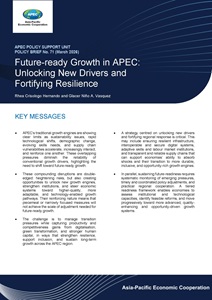
Future-ready Growth in APEC: Unlocking New Drivers and Fortifying Resilience
The Asia-Pacific Economic Cooperation (APEC) is a regional economic forum established in 1989 to leverage the growing interdependence of the Asia-Pacific.
The Asia-Pacific Economic Cooperation (APEC) is a regional economic forum established in 1989 to leverage the growing interdependence of the Asia-Pacific.
APEC ensures that goods, services, investment and people move easily across borders. Members facilitate this trade through faster customs procedures at borders; more favorable business climates behind the border; and aligning regulations and standards across the region.
APEC ensures that goods, services, investment and people move easily across borders. Members facilitate this trade through faster customs procedures at borders; more favorable business climates behind the border; and aligning regulations and standards across the region.
APEC has helped drive economic growth and cooperation across the Asia-Pacific by reducing trade barriers, improving the ease of doing business and strengthening connectivity among economies. These efforts have contributed to rising incomes, expanded trade and greater opportunities for businesses and communities across the region.
APEC has helped drive economic growth and cooperation across the Asia-Pacific by reducing trade barriers, improving the ease of doing business and strengthening connectivity among economies. These efforts have contributed to rising incomes, expanded trade and greater opportunities for businesses and communities across the region.
APEC brings together governments, businesses and stakeholders to collaborate on shared priorities. Explore opportunities to participate in events, contribute to initiatives and engage with APEC’s work across the region.
APEC brings together governments, businesses and stakeholders to collaborate on shared priorities. Explore opportunities to participate in events, contribute to initiatives and engage with APEC’s work across the region.
Reports
•October 1999
Published Under
SOM Steering Committee on Economic and Technical Cooperation (SCE), Human Resources Development Working Group (HRDWG)
Accessed
1983
Pages
126
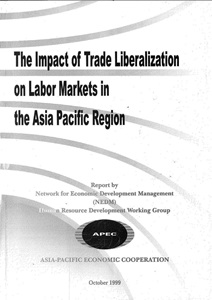
This publication complements the report of the Economic Committee on the Impact of Trade Liberalization in APEC, November 1997. Both studies use simulations of a Computable General Equilibrium (CGE) model. The objective of this report is to present the quantitative analysis of the impact of trade liberalization in Asia-Pacific economies on the sectoral allocations of labor demand to compare the impact of liberalization on labor markets in different Asia-Pacific economies.