Proceedings
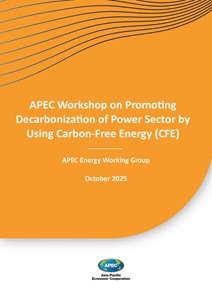
APEC Workshop on Promoting Decarbonization of Power Sector by Using Carbon-Free Energy (CFE)
The Asia-Pacific Economic Cooperation (APEC) is a regional economic forum established in 1989 to leverage the growing interdependence of the Asia-Pacific.
APEC ensures that goods, services, investment and people move easily across borders. Members facilitate this trade through faster customs procedures at borders; more favorable business climates behind the border; and aligning regulations and standards across the region.
APEC works to help all residents of the Asia-Pacific participate in the growing economy.
Capacity building projects play an important role in helping translate APEC's goals into reality.

Reports
•April 2021
Download Report
2MB
Published Under
APEC Secretariat, APEC Policy Support Unit
Accessed
4123
Pages
9
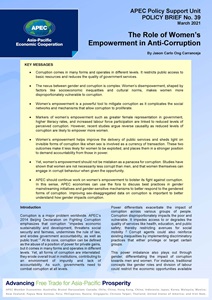
This policy brief discusses how women’s empowerment is an important tool for anti-corruption efforts in APEC. It provides a literature review of the nexus between gender and corruption, outlining how women experience corruption differently from men due to existing forms of disempowerment. It then shows how women’s empowerment can help dismantle the mechanisms that allow corruption to proliferate. While the policy brief highlights that women’s empowerment alone is not sufficient to eradicate corruption, it discusses how APEC policymakers can use gender mainstreaming and gender-sensitive mechanisms to craft policies to deal with gendered forms of corruption.