Pub MailChimp Test 10thOct
The Asia-Pacific Economic Cooperation (APEC) is a regional economic forum established in 1989 to leverage the growing interdependence of the Asia-Pacific.
The Asia-Pacific Economic Cooperation (APEC) is a regional economic forum established in 1989 to leverage the growing interdependence of the Asia-Pacific.
APEC ensures that goods, services, investment and people move easily across borders. Members facilitate this trade through faster customs procedures at borders; more favorable business climates behind the border; and aligning regulations and standards across the region.
APEC ensures that goods, services, investment and people move easily across borders. Members facilitate this trade through faster customs procedures at borders; more favorable business climates behind the border; and aligning regulations and standards across the region.
APEC has helped drive economic growth and cooperation across the Asia-Pacific by reducing trade barriers, improving the ease of doing business and strengthening connectivity among economies. These efforts have contributed to rising incomes, expanded trade and greater opportunities for businesses and communities across the region.
APEC has helped drive economic growth and cooperation across the Asia-Pacific by reducing trade barriers, improving the ease of doing business and strengthening connectivity among economies. These efforts have contributed to rising incomes, expanded trade and greater opportunities for businesses and communities across the region.
APEC brings together governments, businesses and stakeholders to collaborate on shared priorities. Explore opportunities to participate in events, contribute to initiatives and engage with APEC’s work across the region. 2026
APEC brings together governments, businesses and stakeholders to collaborate on shared priorities. Explore opportunities to participate in events, contribute to initiatives and engage with APEC’s work across the region. 2026

Reports
•December 2025
Download Report
52MB
Published Under
SOM Steering Committee on Economic and Technical Cooperation (SCE), Policy Partnership on Science, Technology and Innovation (PPSTI)
Accessed
22
Pages
115
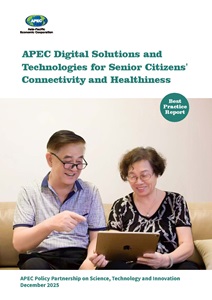
As APEC economies experience unprecedented demographic change, this report explores how digital solutions and technologies can enhance the connectivity and healthiness of older adults across the region. Grounded in the WHO’s framework on functional ability and intrinsic capacity, the study translates these concepts into four practical dimensions: digital connectivity, digital literacy and capacity building, digital health solutions, and caregiver support. Drawing on desk research, policy review, expert interviews, workshop insights, and best practices from APEC economies, the report showcases diverse approaches—from community-based peer mentoring and age-friendly digital ecosystems to telehealth and AI systems, and robotics applications. It concludes with policy recommendations to bridge infrastructure gaps, embed digital literacy into lifelong learning, integrate digital health and technologies into economy-wide systems, and strengthen caregiver support through innovation.