



APEC operates as a cooperative, multilateral economic and trade forum. It is the only international intergovernmental grouping in the world committed to reducing barriers to trade and investment without requiring its members to enter into legally binding obligations.
APEC operates on the basis of voluntary cooperation and consensus. Its decisions are non-binding, allowing economies with diverse systems and levels of development to work together in a flexible and pragmatic way.
APEC achieves its goals by promoting dialogue and arriving at decisions on a consensus basis, giving equal weight to the views of all members.
Our policy level and working level
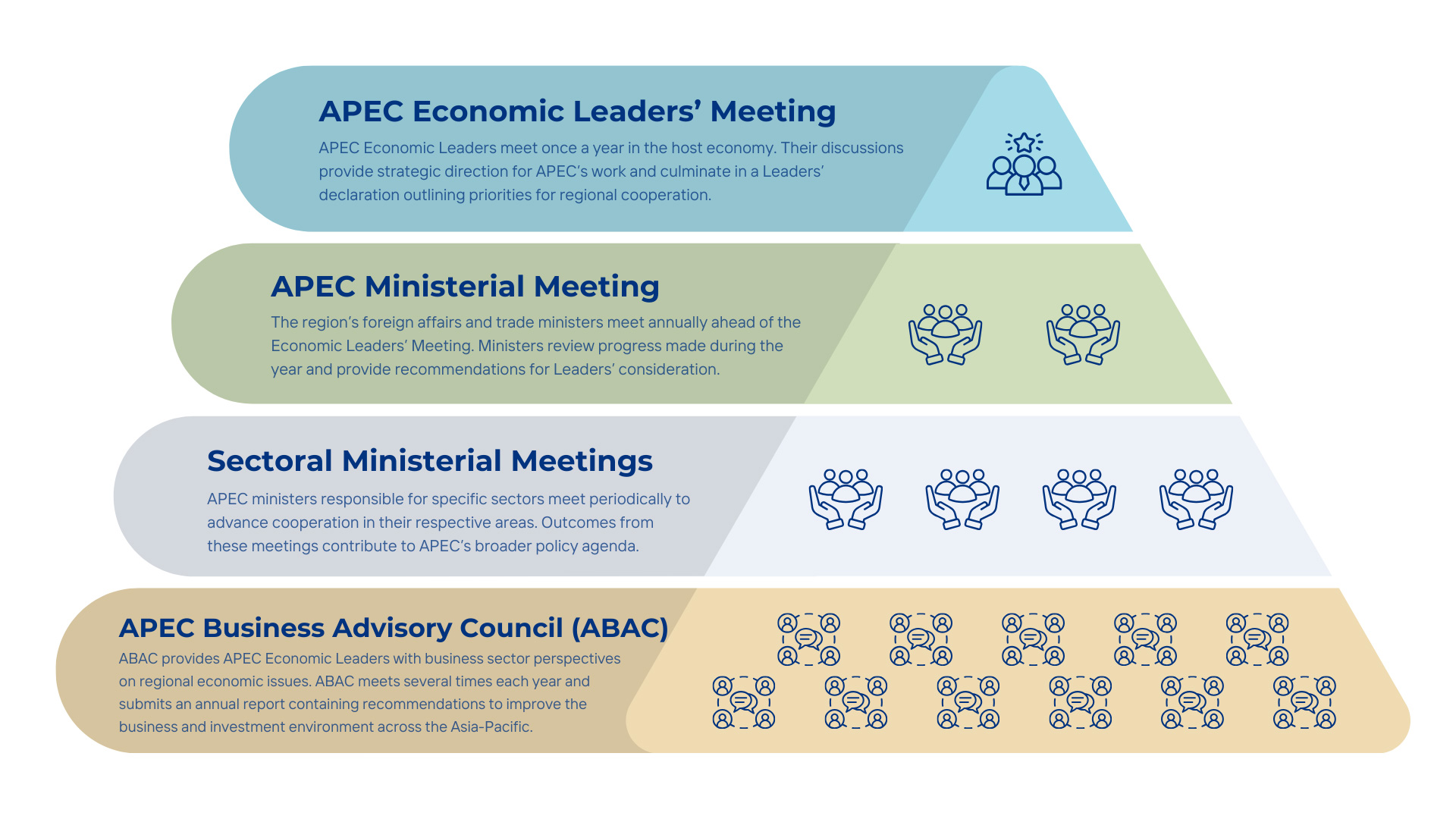
APEC’s policy direction is guided by the APEC Economic Leaders, who meet annually at the APEC Economic Leaders’ Meeting to provide strategic direction for regional economic cooperation. Their discussions set the priorities that guide APEC’s work across the Asia-Pacific.
Each year, APEC ministers responsible for foreign affairs and trade meet at the APEC Ministerial Meeting to review progress and advance policy priorities. Ministers also convene sectoral meetings in areas such as finance, energy, education, transportation and small and medium enterprises to strengthen cooperation in their respective fields.
The APEC Business Advisory Council (ABAC) provides APEC Economic Leaders with business sector perspectives on regional economic issues. Through regular meetings and an annual report, ABAC offers recommendations to help improve the business and investment environment across the region.
 While APEC Economic Leaders and ministers set the forum’s strategic direction, much of APEC’s work is carried forward at the working level. Officials and experts from the 21 member economies collaborate throughout the year to advance the priorities agreed by leaders and ministers.
Senior Officials’ Meeting
At the center of this process are APEC senior officials, who coordinate APEC’s work program and guide cooperation across the forum. Through the Senior Officials’ Meeting, they oversee the activities of committees, working groups and task groups, and develop recommendations for ministers and APEC Economic Leaders. Senior officials typically meet several times each year under the leadership of the host economy.
Committees
Four main committees help coordinate APEC’s work and ensure that initiatives remain aligned with Leaders’ and ministers’ priorities:
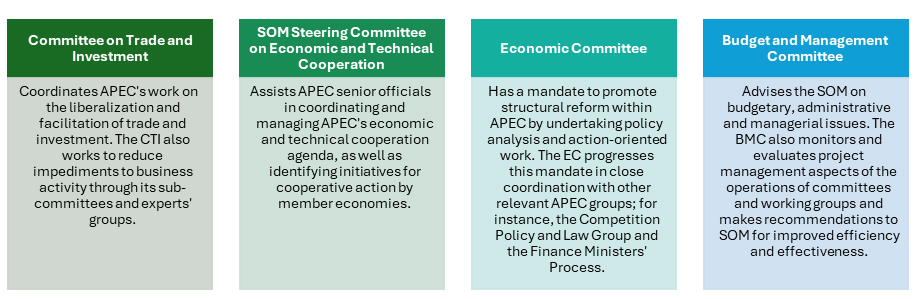
These committees guide APEC’s work programs and ensure coordination across the forum.
Working Groups and Expert Groups
Supporting the committees are working groups, expert groups and task groups, which bring together officials, technical experts and stakeholders to collaborate on specific policy areas.
These groups carry out much of APEC’s practical work, including sharing best practices, conducting research and implementing capacity-building initiatives across the region. Through this network of groups, APEC economies cooperate on a wide range of issues from trade facilitation and digital economy to energy, health and small and medium enterprises.

How is APEC funded?
APEC activities are centrally funded by annual contributions from APEC member economies presently totaling USD5 million. These contributions are used to fund the APEC Secretariat in Singapore and various projects which support APEC's economic and trade goals.
Member economies also provide voluntary contributions to support projects that advance APEC's trade and investment liberalization and facilitation goals and to meet capacity-building needs, especially for APEC developing economies.
Member economies also provide considerable resources to assist the operation of APEC. These include the secondment of professional staff to the Secretariat; the hosting of meetings; and partial or full funding of some projects.