Pub MailChimp Test 10thOct
The Asia-Pacific Economic Cooperation (APEC) is a regional economic forum established in 1989 to leverage the growing interdependence of the Asia-Pacific.
The Asia-Pacific Economic Cooperation (APEC) is a regional economic forum established in 1989 to leverage the growing interdependence of the Asia-Pacific.
APEC ensures that goods, services, investment and people move easily across borders. Members facilitate this trade through faster customs procedures at borders; more favorable business climates behind the border; and aligning regulations and standards across the region.
APEC ensures that goods, services, investment and people move easily across borders. Members facilitate this trade through faster customs procedures at borders; more favorable business climates behind the border; and aligning regulations and standards across the region.
APEC has helped drive economic growth and cooperation across the Asia-Pacific by reducing trade barriers, improving the ease of doing business and strengthening connectivity among economies. These efforts have contributed to rising incomes, expanded trade and greater opportunities for businesses and communities across the region.
APEC has helped drive economic growth and cooperation across the Asia-Pacific by reducing trade barriers, improving the ease of doing business and strengthening connectivity among economies. These efforts have contributed to rising incomes, expanded trade and greater opportunities for businesses and communities across the region.
APEC brings together governments, businesses and stakeholders to collaborate on shared priorities. Explore opportunities to participate in events, contribute to initiatives and engage with APEC’s work across the region. 2026
APEC brings together governments, businesses and stakeholders to collaborate on shared priorities. Explore opportunities to participate in events, contribute to initiatives and engage with APEC’s work across the region. 2026
Proceedings
•March 2026
Download Report
17MB
Published Under
SOM Steering Committee on Economic and Technical Cooperation (SCE), Energy Working Group (EWG)
Accessed
38
Pages
133
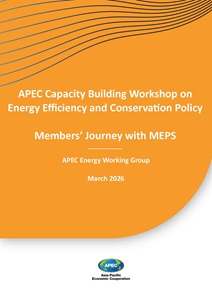
The Capacity Building Workshop on Energy Efficiency and Conservation Policy: “Members’ Journey with MEPS” was held on 18 November 2025 in Seoul, Korea.
The workshop recognized MEPS as one of the most effective and scalable policy tools for promoting energy efficiency, reducing greenhouse gas emissions, and advancing APEC’s shared goals of sustainable and inclusive economic growth. As energy demand continues to increase across the region, MEPS play a vital role in improving energy productivity, enhancing energy security, and supporting the transition toward net-zero economies.
Anchored by the theme “Members’ Journey with MEPS”, the workshop provided a platform for member economies to reflect on their implementation experiences, identify common challenges, and explore opportunities for collaboration. Through expert presentations, host economy case studies, and interactive breakout sessions, participants examined strategies for MEPS design, implementation, and evaluation—particularly for key product categories such as lighting and air conditioners.
APEC economies are at different stages of MEPS development, but the workshop identified clear, actionable priorities for strengthening MEPS implementation across the region. The recommendations developed from the workshop will provide key guidance tailored to economies at varying levels of MEPS maturity and highlight cross-cutting areas where collaboration, capacity building, and evidence-based policy design can accelerate progress.