Reports
Publication Test CWM
The Asia-Pacific Economic Cooperation (APEC) is a regional economic forum established in 1989 to leverage the growing interdependence of the Asia-Pacific.
The Asia-Pacific Economic Cooperation (APEC) is a regional economic forum established in 1989 to leverage the growing interdependence of the Asia-Pacific.
APEC ensures that goods, services, investment and people move easily across borders. Members facilitate this trade through faster customs procedures at borders; more favorable business climates behind the border; and aligning regulations and standards across the region.
APEC ensures that goods, services, investment and people move easily across borders. Members facilitate this trade through faster customs procedures at borders; more favorable business climates behind the border; and aligning regulations and standards across the region.
APEC has helped drive economic growth and cooperation across the Asia-Pacific by reducing trade barriers, improving the ease of doing business and strengthening connectivity among economies. These efforts have contributed to rising incomes, expanded trade and greater opportunities for businesses and communities across the region.
APEC has helped drive economic growth and cooperation across the Asia-Pacific by reducing trade barriers, improving the ease of doing business and strengthening connectivity among economies. These efforts have contributed to rising incomes, expanded trade and greater opportunities for businesses and communities across the region.
APEC brings together governments, businesses and stakeholders to collaborate on shared priorities. Explore opportunities to participate in events, contribute to initiatives and engage with APEC’s work across the region. 2026
APEC brings together governments, businesses and stakeholders to collaborate on shared priorities. Explore opportunities to participate in events, contribute to initiatives and engage with APEC’s work across the region. 2026

Reports
•March 2026
Download Report
1MB
Published Under
APEC Secretariat, APEC Policy Support Unit
Accessed
32
Pages
15
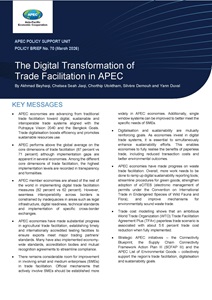
This policy brief examines how regional trade systems are evolving beyond procedural simplification toward digital, sustainable and interoperable trade systems, aligned with the APEC Putrajaya Vision 2040 and the Bangkok Goals. It highlights that APEC performs above the global average on the core dimensions of trade facilitation, achieving 87 percent, with member economies leading in the implementation of digital trade facilitation measures at 82 percent.
Key findings show that digitalisation and sustainability are mutually reinforcing. Trade digitalisation boosts efficiency and promotes sustainable resource use, while a full transition to a paperless trade scenario is associated with about a 5.6 percent reduction in trade costs. The brief also highlights that strategic APEC initiatives, such as the APEC Connectivity Blueprint and the Supply Chain Connectivity Framework Action Plan, collectively support the region’s trade facilitation, digitalisation and sustainability objectives.