Reports
Future-ready Growth in APEC: Unlocking New Drivers and Fortifying Resilience
The Asia-Pacific Economic Cooperation (APEC) is a regional economic forum established in 1989 to leverage the growing interdependence of the Asia-Pacific.
The Asia-Pacific Economic Cooperation (APEC) is a regional economic forum established in 1989 to leverage the growing interdependence of the Asia-Pacific.
APEC ensures that goods, services, investment and people move easily across borders. Members facilitate this trade through faster customs procedures at borders; more favorable business climates behind the border; and aligning regulations and standards across the region.
APEC ensures that goods, services, investment and people move easily across borders. Members facilitate this trade through faster customs procedures at borders; more favorable business climates behind the border; and aligning regulations and standards across the region.
APEC has helped drive economic growth and cooperation across the Asia-Pacific by reducing trade barriers, improving the ease of doing business and strengthening connectivity among economies. These efforts have contributed to rising incomes, expanded trade and greater opportunities for businesses and communities across the region.
APEC has helped drive economic growth and cooperation across the Asia-Pacific by reducing trade barriers, improving the ease of doing business and strengthening connectivity among economies. These efforts have contributed to rising incomes, expanded trade and greater opportunities for businesses and communities across the region.
APEC brings together governments, businesses and stakeholders to collaborate on shared priorities. Explore opportunities to participate in events, contribute to initiatives and engage with APEC’s work across the region.
APEC brings together governments, businesses and stakeholders to collaborate on shared priorities. Explore opportunities to participate in events, contribute to initiatives and engage with APEC’s work across the region.
Manuals
•November 2017
Download Report
14MB
Published Under
SOM Steering Committee on Economic and Technical Cooperation (SCE), Small and Medium Enterprises Working Group (SMEWG)
Accessed
7510
Pages
33
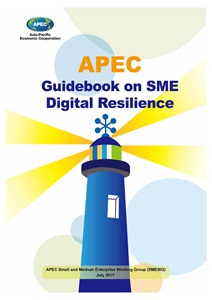
Most SMEs without crisis response experience or capabilities often find themselves in a quandary and are at a loss as to who to turn to for help in the event of a digital attack. Even when they manage to implement some form of internal measures, the results of their chosen remedies usually do not materialize quickly enough to be effective. Post recovery is a race against time. How should SMEs prepare themselves for this challenging task?
Chinese Taipei conducted a cross-border collaboration in 2017 with experts from the fields of digital security and business continuity planning such as Trend Micro and Belfor and gave birth to APEC SME O2O Expert Network. Relevant experts based in the Asia-Pacific were invited to develop this Guidebook in the hopes of providing SMEs in the region with some tools to strengthen their digital competitiveness and resilience so as to enable quality growth in the digital era.