Reports
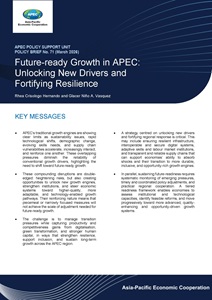
Future-ready Growth in APEC: Unlocking New Drivers and Fortifying Resilience
The Asia-Pacific Economic Cooperation (APEC) is a regional economic forum established in 1989 to leverage the growing interdependence of the Asia-Pacific.
The Asia-Pacific Economic Cooperation (APEC) is a regional economic forum established in 1989 to leverage the growing interdependence of the Asia-Pacific.
APEC ensures that goods, services, investment and people move easily across borders. Members facilitate this trade through faster customs procedures at borders; more favorable business climates behind the border; and aligning regulations and standards across the region.
APEC ensures that goods, services, investment and people move easily across borders. Members facilitate this trade through faster customs procedures at borders; more favorable business climates behind the border; and aligning regulations and standards across the region.
APEC has helped drive economic growth and cooperation across the Asia-Pacific by reducing trade barriers, improving the ease of doing business and strengthening connectivity among economies. These efforts have contributed to rising incomes, expanded trade and greater opportunities for businesses and communities across the region.
APEC has helped drive economic growth and cooperation across the Asia-Pacific by reducing trade barriers, improving the ease of doing business and strengthening connectivity among economies. These efforts have contributed to rising incomes, expanded trade and greater opportunities for businesses and communities across the region.
APEC brings together governments, businesses and stakeholders to collaborate on shared priorities. Explore opportunities to participate in events, contribute to initiatives and engage with APEC’s work across the region.
APEC brings together governments, businesses and stakeholders to collaborate on shared priorities. Explore opportunities to participate in events, contribute to initiatives and engage with APEC’s work across the region.
Proceedings
•March 2010
Download Report
6MB
Published Under
SOM Steering Committee on Economic and Technical Cooperation (SCE), Agricultural Technical Cooperation Working Group (ATCWG)
Accessed
35650
Pages
362
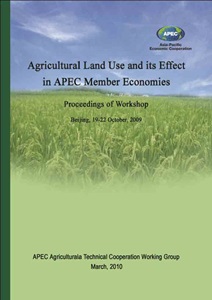
Agricultural Land Use and its Effect in APEC Member Economies October 2009, Proceedings (Printed in March 2010) is a collection of proccedings of the above workshop. The workshop aimed at improving the level of agricultural land use management and the awareness of the effect of agricultural land use and its change on climatic change and food security.
Invited Speeches
Session 1: Monitoring and assessment of agricultral land use
- Agricultural Land use Mapping and Decision-Support in Australia
- An Integrated Modeling Framework to Understand Agricultural Land-Use Changes at a Global-scale
- Cultivated Land Quality Change and Engineering Countermeasures in Northeast China
- A Neural Network Method for Retrieval of Land Surface Temperature and Emissivity from ASTER1B Data
- The Study of Applying Hyper-spectral Remote Sensing Technology in Soil Moisture Monitoring
- Regional Land Suitability Assessment for Tree Crops Using Remote Sensing and GIS
- Efficiency Analysis of Agricultural Land use Based on DEA Method - a Case Study Among APEC Economies
- Spatial Variability of Nutrient Properties in Soil of Jilin Middle Plain
- Multiple Cropping Index from Spot NDVI Time Series Using Wavelet Transform
Session 2: Agricultral land use and its effect on climate change and food security
- Land Use and Land Cover Change in Heilongjiang Province and Its Impact on Food Security
- Land Utilization and Agricultural Development in Viet Nam
- Applying High Technology to Enhance Agricultural Land Protection and Rational Utilization
- Agricultural Land Use and Its Effect in Thailand
- Study on Impact Evaluation of Regional Arable Land Change on Food Crops Productivity
- A simulation on Spatial Distribution of the Per unit Area Yield of Maize by Statistics
- The Effect of Agricultural Land use on Climate Chage and Food Security
- Conservation of the Northeast Black Soil Area and China‘s Food Security
- The Protection of Cultivated Land Based on Food Security in the Economic Area of Zhujiang Delta
- GIS Modeling Land Use/Cover Change and Its Effects on Grain Production in China
- Agricultural Land use in Mexico
- Agricultural Land Use Changes and Its Implications on Food Security in Northeast China
Session 3: Agricultural land use management and regional planning
- Estate Crop Land Use Development for Soil and Water Conservation, C Stock, and Stimulant Economic Recovery
- The Change of Land Resources and the Sustainable Development of Metropolis Modern Agriculture in Beijing
- Current Status and Development Orientation of Agriculture in Viet Nam
- Simulating Annealing for Land-use Planning
- Agricultural Land Use Policy and Management in Chinese Taipei
- Urban-rural Fringe Land-use Problems and Countermeasures of Beijing
- GIS-based Multicriteria Analysis for Agricultural Land Use Planning in the Western Region of Quang Tri Province, Viet Nam
Session 4: Public Participation and Education
- Flexible Farming System Strategies for Economic and Environmental Sustainability: Reflections on experiences in several developing economies