Reports
Future-ready Growth in APEC: Unlocking New Drivers and Fortifying Resilience
The Asia-Pacific Economic Cooperation (APEC) is a regional economic forum established in 1989 to leverage the growing interdependence of the Asia-Pacific.
The Asia-Pacific Economic Cooperation (APEC) is a regional economic forum established in 1989 to leverage the growing interdependence of the Asia-Pacific.
APEC ensures that goods, services, investment and people move easily across borders. Members facilitate this trade through faster customs procedures at borders; more favorable business climates behind the border; and aligning regulations and standards across the region.
APEC ensures that goods, services, investment and people move easily across borders. Members facilitate this trade through faster customs procedures at borders; more favorable business climates behind the border; and aligning regulations and standards across the region.
APEC has helped drive economic growth and cooperation across the Asia-Pacific by reducing trade barriers, improving the ease of doing business and strengthening connectivity among economies. These efforts have contributed to rising incomes, expanded trade and greater opportunities for businesses and communities across the region.
APEC has helped drive economic growth and cooperation across the Asia-Pacific by reducing trade barriers, improving the ease of doing business and strengthening connectivity among economies. These efforts have contributed to rising incomes, expanded trade and greater opportunities for businesses and communities across the region.
APEC brings together governments, businesses and stakeholders to collaborate on shared priorities. Explore opportunities to participate in events, contribute to initiatives and engage with APEC’s work across the region.
APEC brings together governments, businesses and stakeholders to collaborate on shared priorities. Explore opportunities to participate in events, contribute to initiatives and engage with APEC’s work across the region.
Reports
•May 2021
Download Report
725KB
Published Under
APEC Secretariat, APEC Policy Support Unit
Accessed
12440
Pages
42
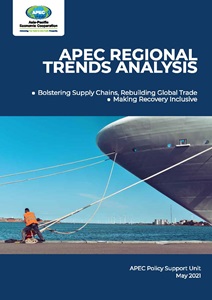
There is nothing quite like a global pandemic to focus minds on where our basic necessities come from. The theme chapter discusses how COVID-19 has affected the functioning of global supply chains that provide us with access to food, medicines, technology, and other necessities. It shows how the pursuit of efficiency and cost considerations have dominated the formation of current global value chains, but have exposed them to risk of external shocks like the current pandemic and natural disasters. Some firms have taken initial actions in the name of improving resilience—such as withdrawing from international trade—but these, in the longer term, may achieve the opposite results. Improving resiliency of global supply chains will not be a costless exercise, but one that will require collaborative partnership among firms and economies, and regional cooperation.
The next chapter on economic and trade trends shows that the region posted a softer contraction of 1.9 percent in 2020, better than the earlier projection of -2.7 percent. However, trading activity in the region was still adversely affected by the combined impact of the temporary closure of borders, disruptions in global supply chains, proliferation of trade-restrictive measures, and persistent trade and technology tensions. The APEC region is expected to grow by 6.3 percent in 2021, but the recovery is going to be uneven, with unequal impacts on women, the youth, the poor, indigenous groups and other vulnerable segments of society. Collaborative efforts could ensure that COVID-19 is effectively managed everywhere, ensuring access to vaccines, treatments and medical supplies for a healthier population and leading to a steady reopening of businesses and borders toward a sustainable and inclusive economic recovery.
Related Infographics